
Capture a flight on your watch
Capture a flight from your wrist. The watch walks you through one step per screen, stamps your times and location, sets meters and airfields with the Digital Crown, lets you review and adjust the times before you submit, and creates a real usage log against your booking, the same log you would create on the phone’s Log Flight screen.
Before you start
Section titled “Before you start”- Install the watch app and sign in on the paired iPhone (see Install the watch app).
- You need your own confirmed booking, the same as logging a flight on the phone.
- Keep your iPhone within range. The watch asks the phone for nearby airfields and submits the flight through the phone.
Open the capture wizard
Section titled “Open the capture wizard”When a booking is ready to fly (in its slot, or within two hours either side of its start), the watch opens to a Start Flight screen (the glance is one swipe away). Tap Start Flight to open the wizard. It runs one step per screen, and the Digital Crown always drives the control in front of you.
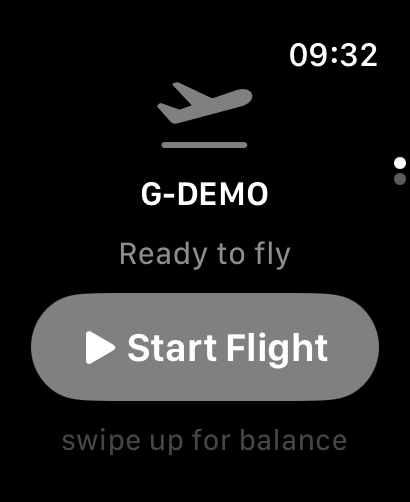
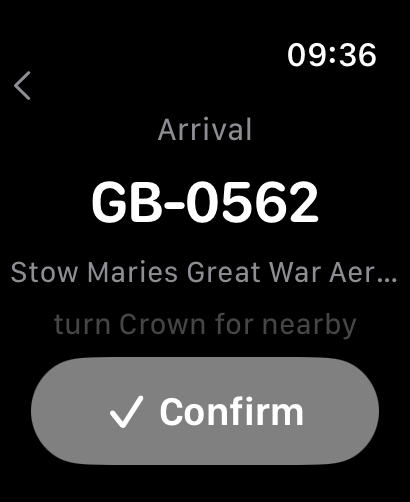
The watch screenshots are captured on a real Apple Watch rather than generated alongside the rest of the documentation, so the aircraft in them still carries an older registration than the G-Q… marks used on every other page.
The steps mirror exactly what your syndicate captures:
- Airfields and landings appear for every aircraft (departure, arrival and the landings count) because a landing fee can apply even when the flight is billed on block time.
- Meter steps appear only when your syndicate reads an engine meter (such as a Tacho or Hobbs). When it bills purely on time, there are no meter screens.
- The flight screen follows the times your syndicate records. You tap the start and end of the span you record: brakes off and on for block time, or takeoff and landing for airborne time. When your syndicate records both, you tap only brakes off and on, and the watch works out takeoff and landing from your syndicate’s taxi time for you to check on the review screen, so you never have to reach for your wrist during takeoff or landing.
A typical airborne aircraft that reads a meter runs: departure airfield → start meter → flight → end meter → landings → arrival airfield → confirm no defects → review.
Work through the steps
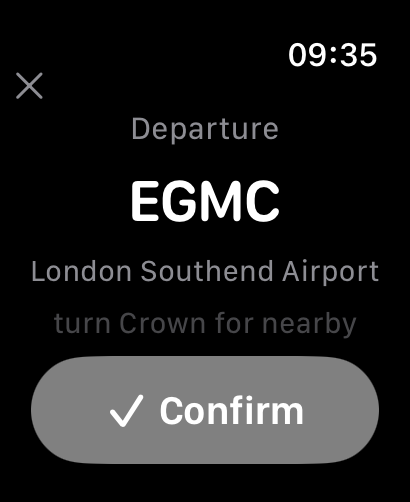
Section titled “Work through the steps”- Departure airfield (aircraft): turn the Crown to pick your departure from the nearby list, ordered by distance from your GPS fix.
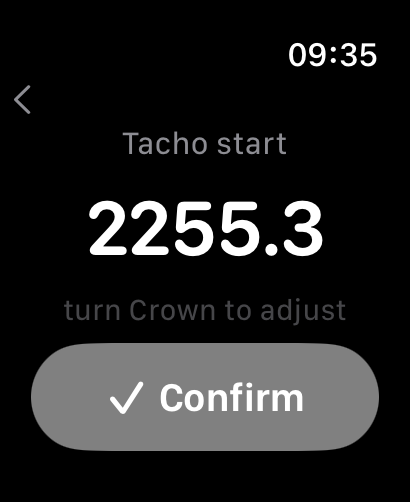
- Start meter (when a meter is read): turn the Crown to set the starting reading. It seeds from the continuity value but you can correct it down if needed.
- Flight: one button at a time stamps the next time as you tap it, along with your location, while a live timer counts the flight. You tap the start and end of the span your syndicate records: brakes off then brakes on for block time, or takeoff then landing for airborne time. When your syndicate records both spans, you still tap only brakes off then brakes on; the watch works out takeoff and landing from the syndicate’s taxi time, ready for you to check and adjust on the review screen.
- End meter (when a meter is read): turn the Crown to set the finishing reading. It seeds from your confirmed start and can only climb.
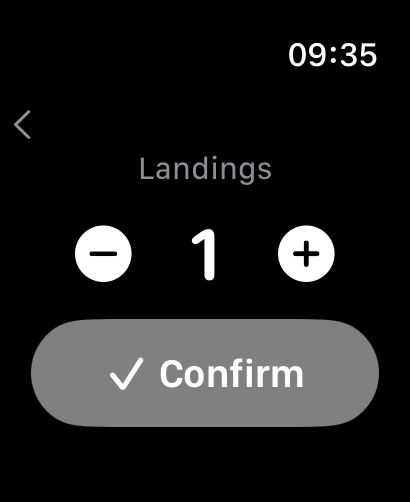
- Landings (aircraft): set the number of landings.
- Arrival airfield (aircraft): pick your arrival from the nearby list.
- Confirm no known defects (aircraft): the pilot-in-command’s per-flight declaration, the same one the phone requires. Tap No known defects to continue. If the aircraft has a defect to report, finish this flight on your phone instead; the watch does not capture defect details, only the clean confirmation.
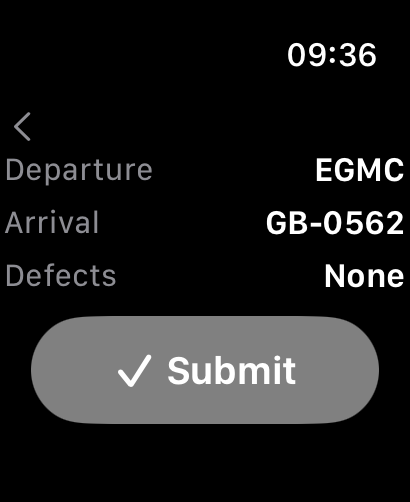
- Review: check the flight over before you submit. Your times are listed in order, each with the length of that leg beside it; tap any time and turn the Crown to nudge it a minute at a time (a time will not cross its neighbour). When the watch has worked out your takeoff and landing (a flight that records both spans), they show as estimates until you confirm or adjust them, and Submit waits until you have. If the engine ran but you did not fly, tap Ground run to drop the airborne times and keep just the block time. When the figures are right, Submit.
What happens on submit
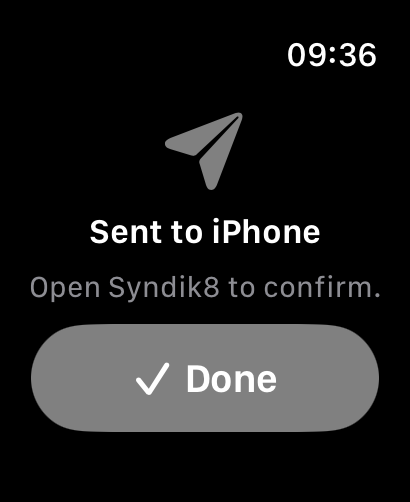
Section titled “What happens on submit”- Phone online: the flight is submitted straight away as a usage log and billed in the normal way. Immediately after you submit, the watch shows Sent to iPhone; once the phone has logged it the screen updates to Logged. There is nothing more to do on the phone.
- Phone offline: the flight is still logged; it is saved on the phone and uploaded automatically when the phone next has a connection. There is no separate draft to submit.
- You are recorded as the pilot in command. There is no name field on the wrist, so the phone fills one in from your profile as it logs the flight, using your display name or your first and last name. If you have set neither, the flight records your account but leaves the pilot’s name blank rather than guessing, and it can be typed in by editing the log. When someone else is flying as pilot in command, log that flight on the phone.
Check it worked
Section titled “Check it worked”When the submit succeeds, the flight appears as a usage log against the booking; check it from the booking’s usage-logs section on the phone or web, exactly as for a flight logged on the phone.
See also
Section titled “See also”- Apple Watch app: the glance and capture surfaces.
- Log a flight: the full phone-side flow and field reference.
- Install the watch app