
Pay your balance
Pay your balance
Section titled “Pay your balance”Pay your outstanding charges to your syndicate by card.
Before you start
Section titled “Before you start”Your syndicate must have its payment account connected, and card payments must be switched on for it. When that is in place and you have charges outstanding, the Pay buttons appear on your My Balance screen. If you do not see them, ask an admin whether the syndicate payment account is connected.
The money goes straight to your syndicate’s own account. Syndik8 does not hold it.
Pay your charges
Section titled “Pay your charges”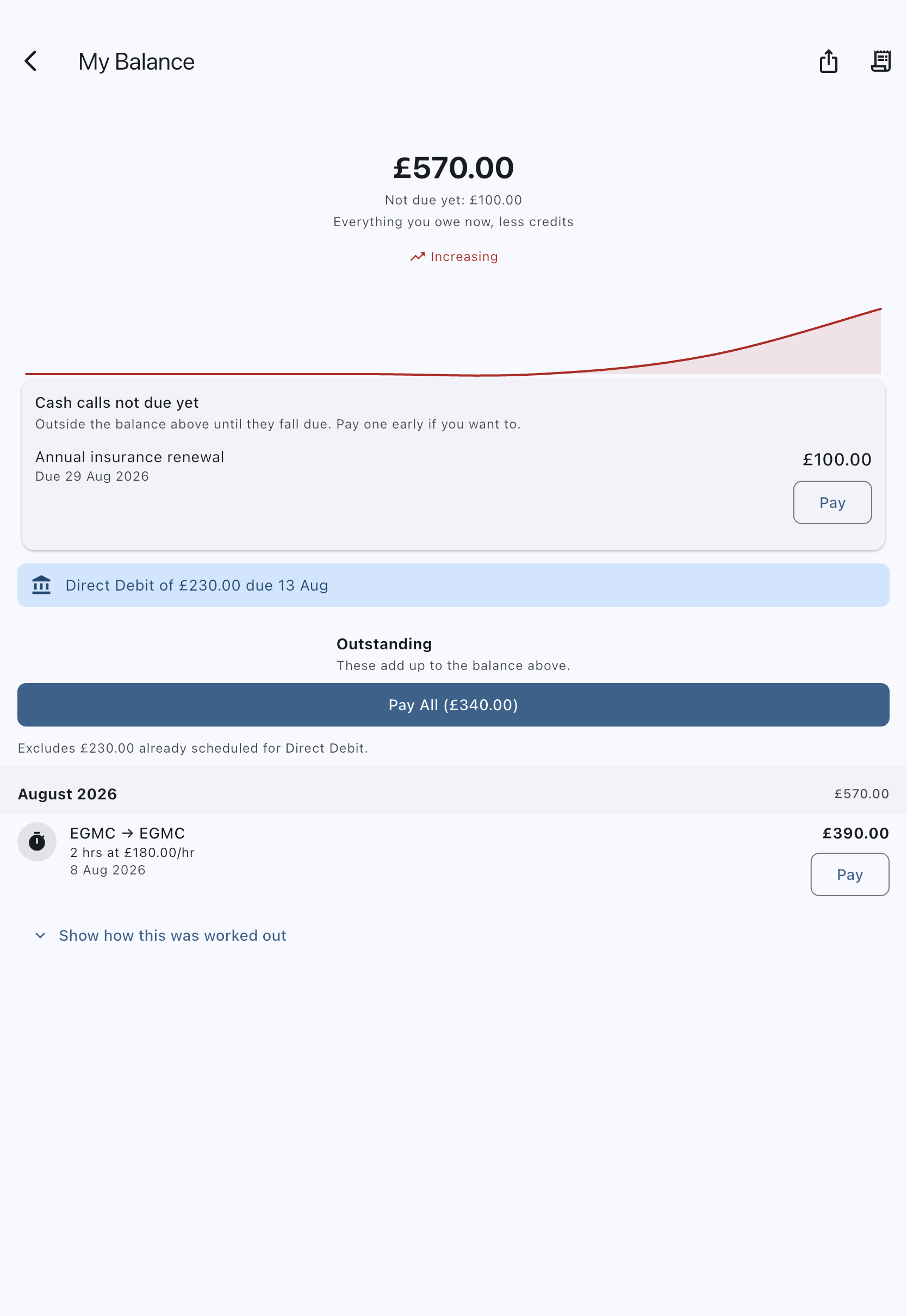
- Open the My Balance screen for your syndicate.
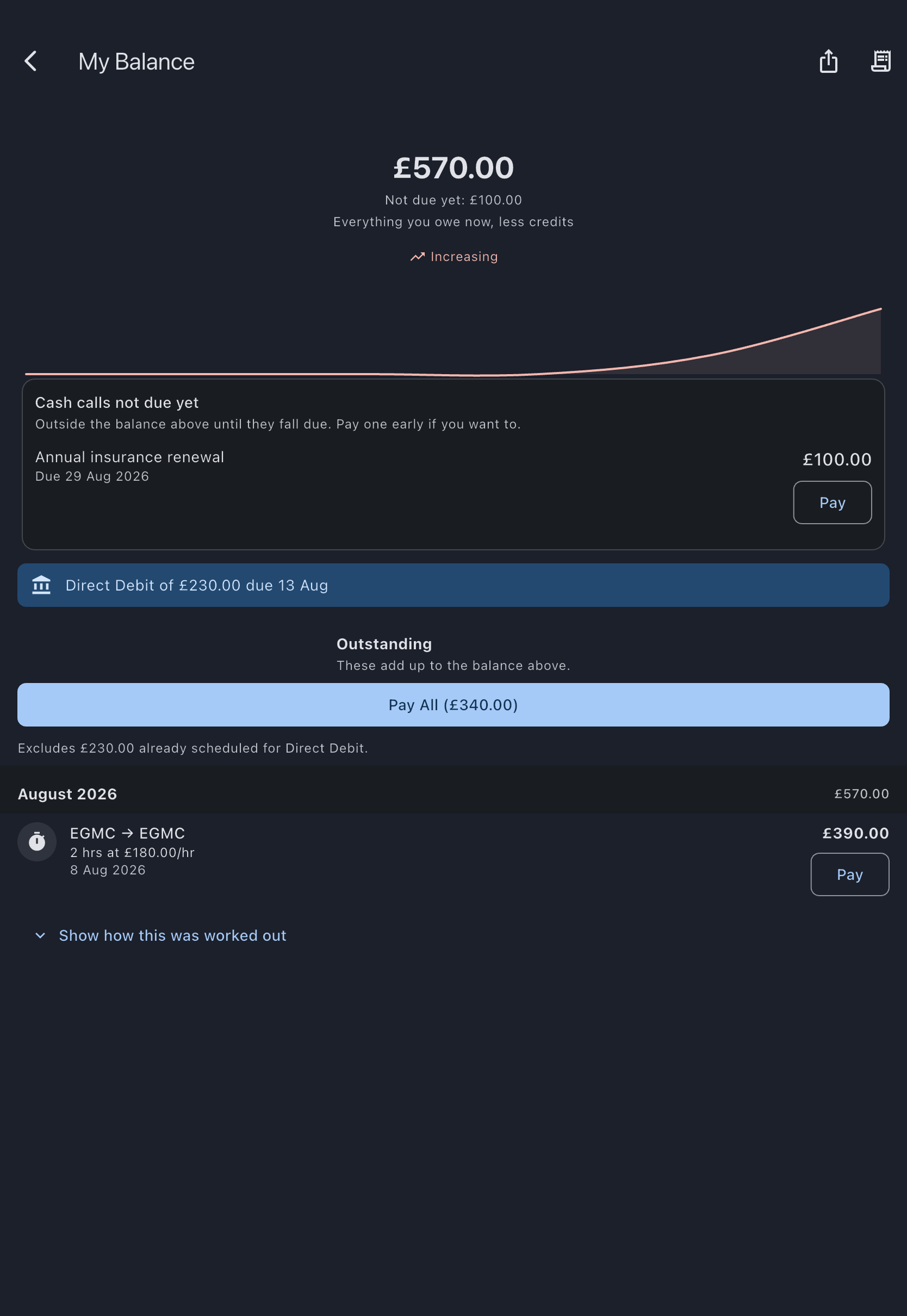
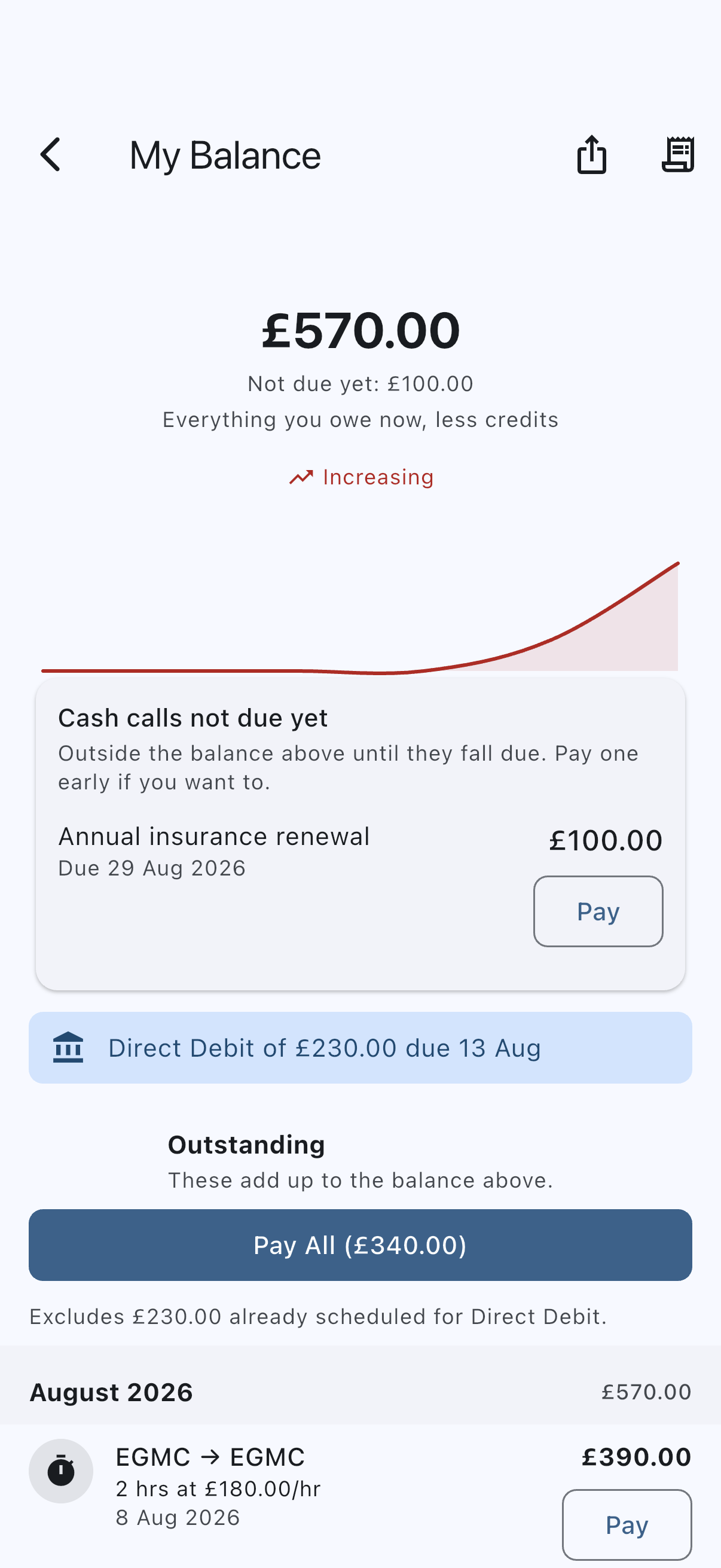
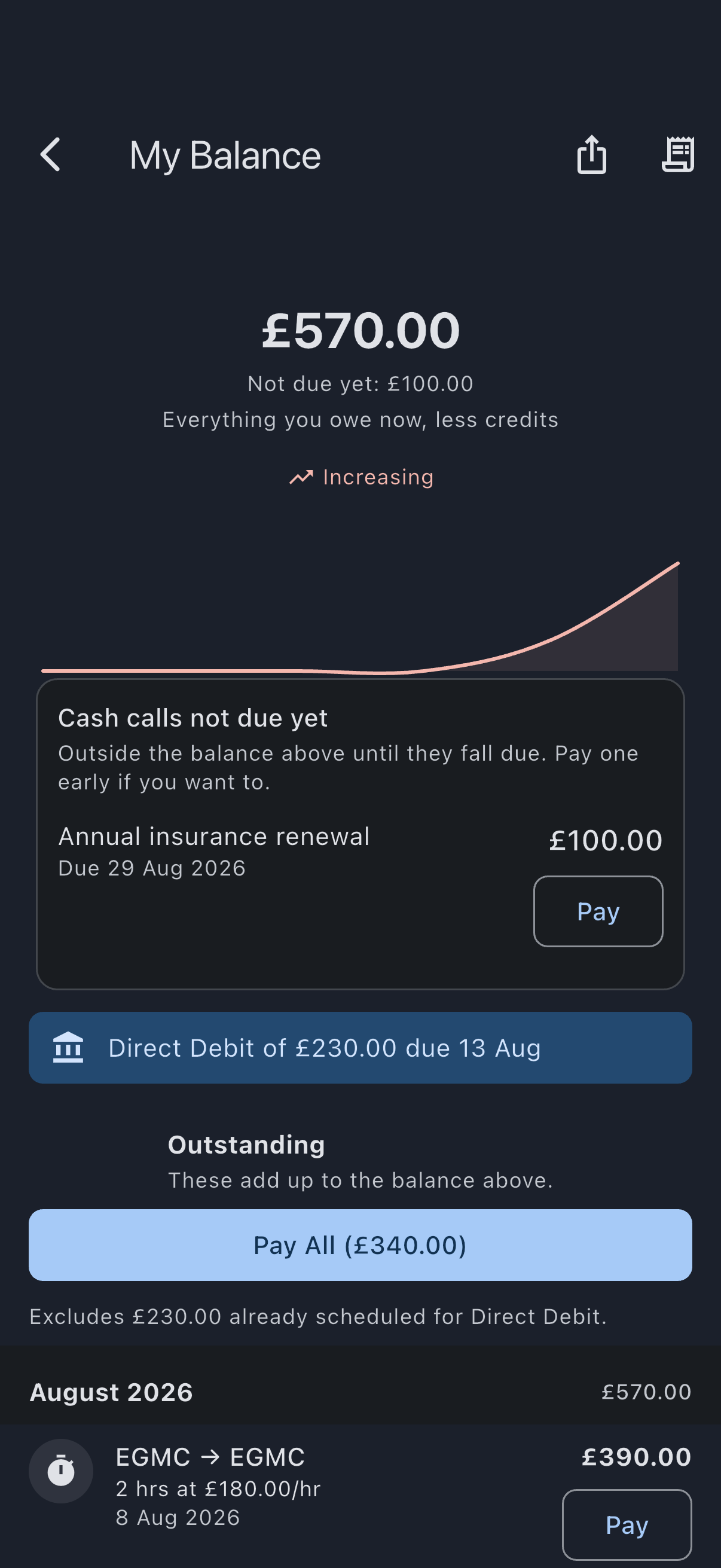
- Find the Outstanding section. It lists everything you still owe, newest first, and those rows add up to the balance shown at the top.
- Tap Pay next to a single row, or Pay All to settle everything payable at once. The Pay All button shows the total amount to be charged.
If you already have a Direct Debit mandate, some rows will carry a DD pill with a date instead of a Pay button, and say that the collection is already scheduled. There is nothing to pay by card on those; Pay All covers only the rows that still have a Pay button, and a line under it names the amount it is leaving out, which is why its total can be lower than the balance above. A row carrying an Awaiting your bank pill is left out for a different reason — see below. 4. Stripe takes over to collect your card details and take the payment. Follow the instructions there, then come back to the app. 5. When the payment succeeds, the row moves to the Settled part of the list and your balance updates. 6. To check a payment afterwards, open Payment History and look for it. Each entry shows what happened to it in a few words — Collected, Waived, Paid with credit, On its way, Not collected, Never requested, Not completed, Cancelled, Returned to you or Undone — and anything that did not simply succeed carries a sentence saying whether any money moved. Undone is the one to read carefully: it means the record of a payment was reversed on the books, so what it covered is owed again, but no money has come back to you. A payment your syndicate has refunded only part of, or refunded without reopening what you owed, stays Collected — it did clear the charges it was for. Money coming back to you shows on your balance and, for a bank refund, takes several working days to arrive.
If you cancel or the payment fails, the row stays in the Outstanding section and you can try again — with one exception. A charge on a payment your bank has taken back and is still looking into cannot be paid again until your bank decides, and its row says so rather than offering a Pay button. See If a row says it is awaiting your bank below.
The same is true if a payment simply does not finish — you close the page part-way, or the connection drops. The row keeps a Not finished badge and its Pay button, and the banner at the top says a card payment was not confirmed. Tap Pay again: within a short window Syndik8 picks up the same payment where you left off, and after that it replaces it with a fresh one. Before it replaces anything it asks your card provider what became of the original, so if that one did go through you are told rather than charged twice. This is worth knowing because the badge sits on a row that still says you owe the money — that is correct, and paying it is what settles it.
If you are holding a credit, tapping Pay on a single row may open a short confirmation first. A single row is charged in full, whereas Pay All and a Direct Debit both take the net after your credit, so paying one row on its own can leave you further in credit than you started. The confirmation names your balance now and what this payment leaves it at, and where Pay All is on screen it names that as the alternative that puts the credit towards the charges. Choose Pay and keep my credit to go ahead, or Cancel to go back with nothing charged.
Pay a cash call early
Section titled “Pay a cash call early”A cash call has a due date, and until that date arrives it is not part of your balance: it is not in the figure at the top, it is not in the Outstanding list, and Pay All does not collect it. It sits in a Cash calls not due yet card above the ledger, showing what it is for, when it falls due, and your share, with a Not due yet total under the balance figure.
If you would rather settle it now, tap Pay on its row in that card. Paying early will not put you into credit, because the charge was not in your balance to start with, and the row leaves the card as soon as it is paid. Do nothing and it simply joins your balance on its due date, with the ordinary Pay button — and if you have a Direct Debit mandate, it is collected with everything else from then on.
A flight appears as one row — its route and date, and one total — rather than as a usage charge plus a row per landing fee. Paying it settles the whole flight. Tap Show how this was worked out to see the individual charges behind the total.
Taking the card is Stripe’s job, not ours, so we do not walk you through that part here and Syndik8 never sees your card number. If a payment gives you trouble, Stripe’s own guidance for payers is the place to look.
If a row says it is awaiting your bank
Section titled “If a row says it is awaiting your bank”If you asked your bank to take back a Direct Debit collection or a card payment, the charges that payment covered are owed again — but nothing can take that money while your bank is still deciding. Those rows carry an Awaiting your bank pill in place of their Pay button, and say that you still owe the charge and that it cannot be paid again until your bank decides.
There is nothing to retry and nothing to fix. A banner under the balance figure names the held total and says why. Pay All leaves those charges out, so its total is lower than the balance above it, and the line under it names the held amount too; if everything you owe is held this way there is no Pay All to caption and the banner carries it alone. Every other row on the screen is paid exactly as usual.
Syndik8 cannot tell you when your bank will decide, and does not guess. When it does decide, one of two things happens on its own: your bank finds against you, the money is gone, and the charge becomes payable like any other — collected with your next Direct Debit if you have a mandate; or your bank finds in your favour, the money comes back, and the charge settles itself against the original payment again.
If you would rather settle it directly in the meantime — by bank transfer, say — ask an admin to record the payment against it. That route stays open while the hold stands.
Pay by Direct Debit instead
Section titled “Pay by Direct Debit instead”Paying by card is a one-off for the charges you select. If you would rather have your balance collected automatically, set up a Direct Debit once. After your mandate is active, your syndicate collects what you owe on its schedule and you receive an advance notice before each collection, so you do not need to pay each charge by hand.
See also
Section titled “See also”- Your balance screen
- Payment History
- Direct Debit
- Reversals: what happens when money goes back