
Set up a payment account
Set up a payment account
Section titled “Set up a payment account”Connect your syndicate payment account so members can pay their balance by card and Direct Debit, with the money landing directly in your syndicate’s own account.
Before you start
Section titled “Before you start”- You must be an admin on the syndicate. The connect controls do not appear for members.
- If you are setting up as a company, have your company registration details to hand. You will also need to flag each director and every owner who holds 25% or more, which you do on their member detail screen, and then ask them to confirm their own personal details. You never type anyone else’s date of birth or home address yourself; each person confirms their own. Nobody is prompted until you ask, so members are never chased for a payment account you have not decided to set up.
- Asking your flagged directors and owners to confirm their details is a shortcut, not a requirement. Everything they give is sent ahead to save them re-typing it. You can finish setup before they respond, but Stripe simply asks anyone still outstanding at that point for their details directly, because their details can only be passed ahead at the moment the account is created.
- Money from member payments lands directly in your syndicate’s connected account; Syndik8 never holds it. Syndik8 takes a platform fee (0.5% by default) from the syndicate side, and your syndicate is the merchant for any refunds or disputes. See how payments work.
- Card and Direct Debit are separate capabilities. They can turn on at different times: card payments may become available before Direct Debit, or the other way round.
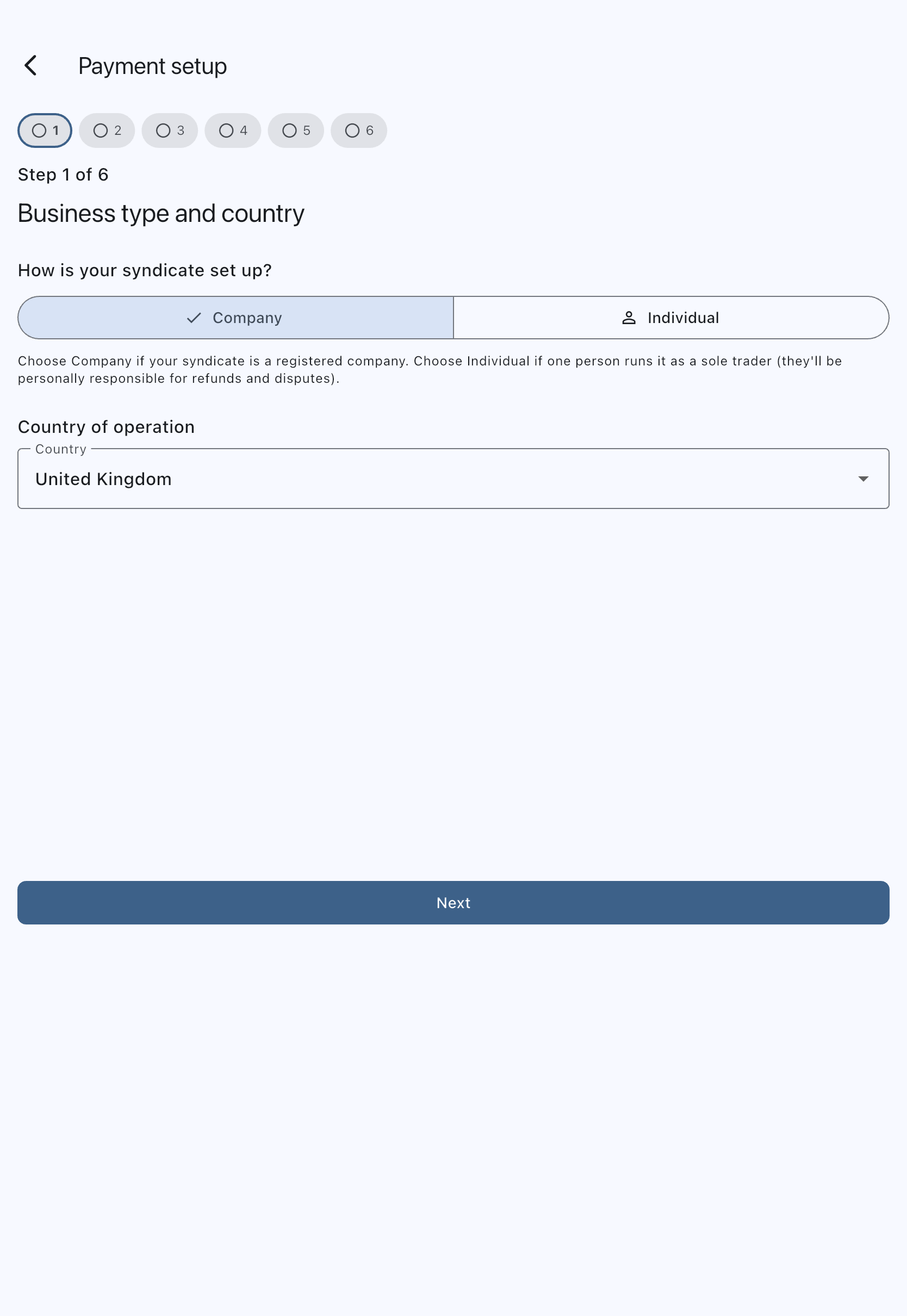
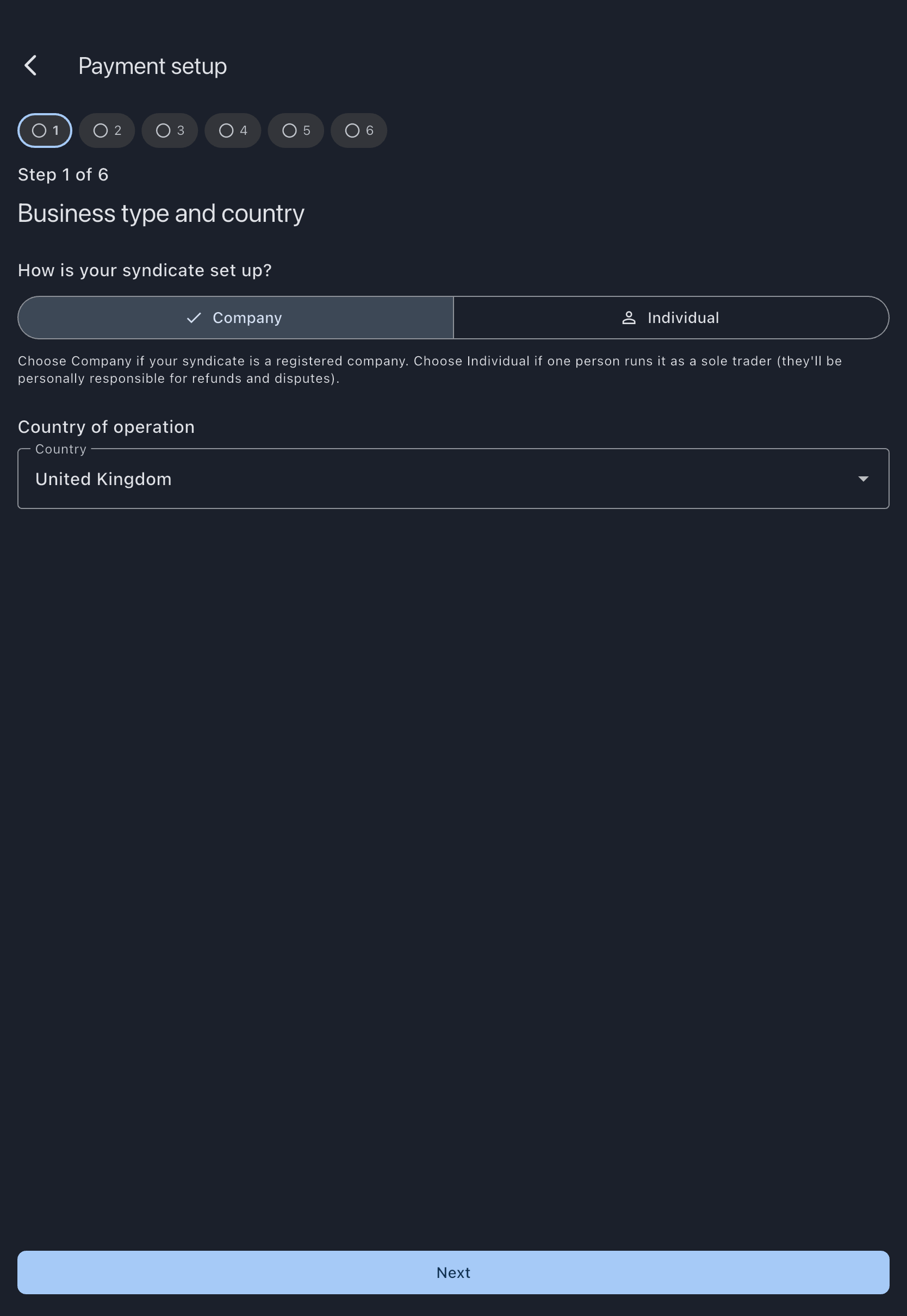
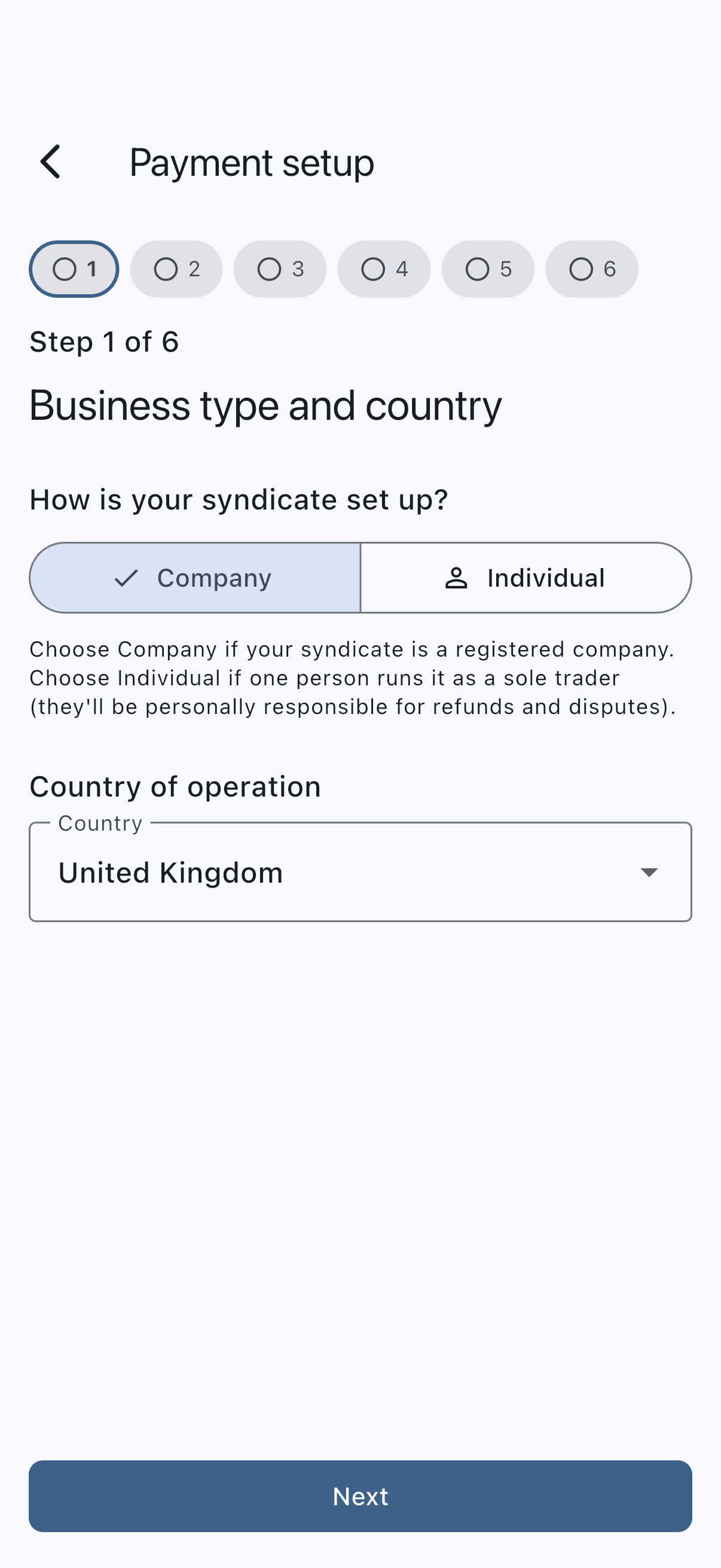
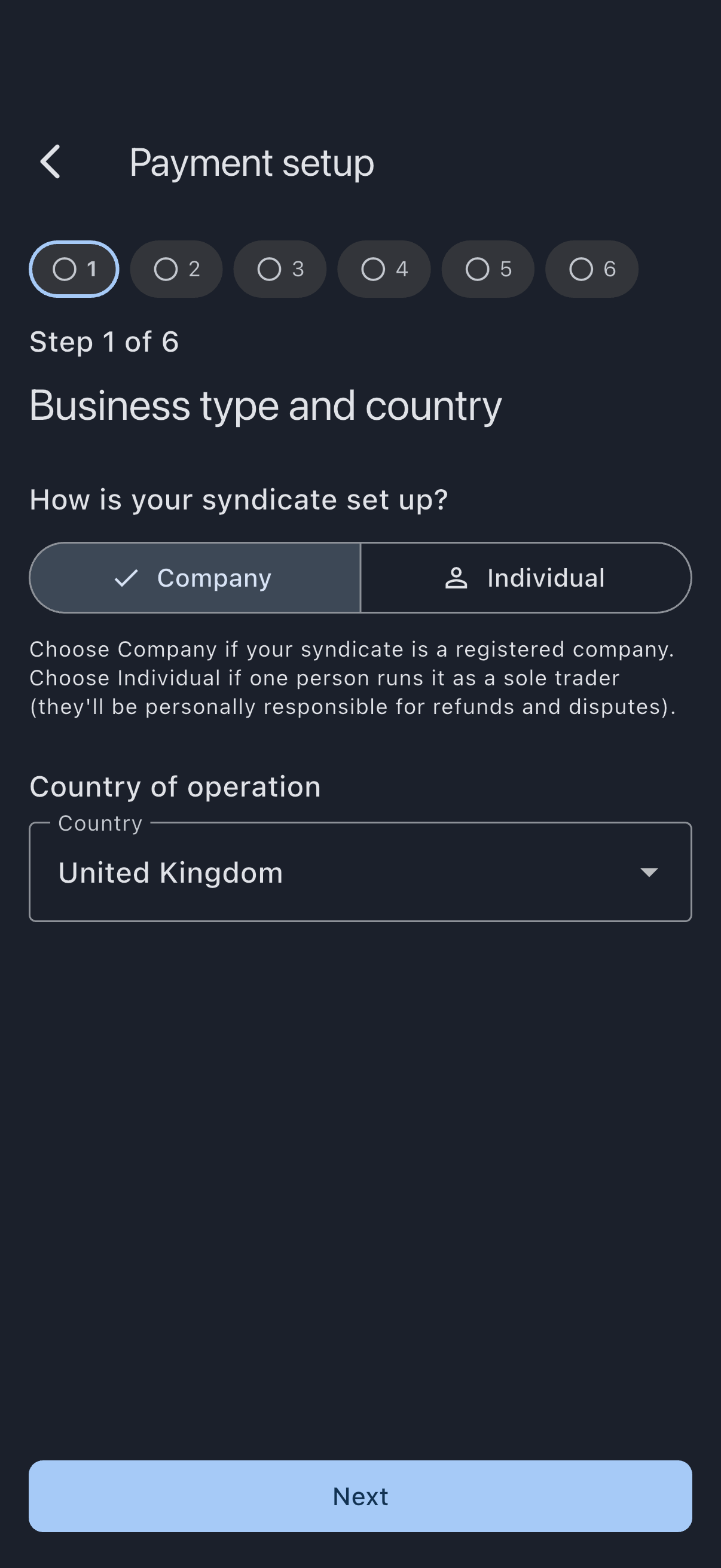
The wizard opens on Business type and country, and the answer you give there shapes every page after it.
- Open the syndicate and go to the Admin tab.
- Tap Payments (under Money).
- Tap Payment account, then under Payment Collection tap Set Up Payments.
- On the first step, Business type and country, choose whether you are a company or an individual / sole trader, and confirm your country. This choice shapes the rest of the wizard.
- If you chose individual / sole trader, the wizard collects your own details and then your bank account, and you tap Finish on the final step.
- If you chose company, work through the remaining five steps in order: Company information, Authorised representative (your date of birth, home address, role and ownership share — your name comes from your profile, so it is not asked for again), Directors and beneficial owners (nothing to fill in: it lists the people you have already flagged), Companies House check (optional — see below), and Bank account last. The business category is a field on Company information, not a step of its own; its default, Membership organisation, is the right answer for most syndicates. A step ticks in the progress strip when it has actually saved; a step you walk past without typing anything sends nothing.
- Company information has two fields Syndik8 never keeps a copy of: the contact email and contact phone. They read as company details, but a four-person syndicate rarely has a switchboard, so in practice they are usually the admin’s own address and mobile — and every active member of your syndicate can read the payment account record. So they behave like the bank digits below: typed into the form, sent to Stripe when you press Finish, and stored nowhere in between. Enter them in the sitting you submit in. If you come back to a part-finished wizard they will be blank, and if you submit without them Stripe simply asks for them on its own pages instead.
- The Bank account step is deliberately last, and it works differently from the others: the sort code, account number and (optionally) the name on the account are not saved anywhere when you type them. They are sent to Stripe only when you press Finish, in the same action that creates the account, and Syndik8 keeps only the last four digits for display. Because Stripe receives the bank with the account, its own pages will not ask you for it again. If you leave the wizard before finishing, you will need to re-enter the numbers — that is the price of them never resting anywhere.
- Below the bank fields, the same step asks for the support email shown to members, under Member support contact. This is the one detail on your account that Stripe shows to the people paying you: it appears on their receipts, and it is the address Stripe gives anyone who queries a charge. It arrives filled in with your own address, so accepting it is one tap — but read it before you do, because on a sole trader account that publishes a personal address to everyone who pays. If you would rather members did not have it, put a shared mailbox here instead. Unlike the bank digits above it, this one is saved with your syndicate. Choose it before you submit, though: it reaches Stripe with the account, and the wizard closes for good once the account exists — after that the address on the account is changed in your Stripe dashboard, not here. Leave it blank and Stripe falls back to the address the account already carries, which is yours.
- On Directors and beneficial owners, tap Ask directors and owners for their details to ask everyone you have flagged. That is the opening ask, and there is only one of it: once you have made it the button is replaced by the date you asked on, and anyone you flag afterwards is prompted automatically. Each flagged person is told — a notification and an email asking them to confirm their date of birth, home address, job title and share of the syndicate, opening straight onto their own form. Chasing whoever does not reply comes next, and is done person by person from the list below rather than by asking everyone a second time. Both channels can be turned off under Verification Details Requested in notification preferences. For anyone you matched to Companies House, that prompt arrives part-filled from the public record: their month and year of birth and a suggested job title are already in place, the day of birth is left blank for them to add (Companies House does not publish it), and the Companies House address is offered as a suggestion behind an “I confirm this is my residential address” tick.
- The same step lists everyone you have flagged, so you can see where each of them is up to. Each row names the person, says whether they are a Company director, a 25%+ shareholder or both, and reads Details confirmed or Details outstanding; a Confirmed: 2 of 4 line above the list is the running total. Chasing happens here, one person at a time: every row reading Details outstanding carries a Remind button that notifies and emails that person and nobody else. Rows reading Details confirmed carry no button — anyone who has finished is never reminded again. Nudge as often as you need to, but only every few hours: press it again too soon and the row tells you how long is left instead of sending anything. If nobody is flagged the step says so and points you at the member detail screen. You do not have to wait for everyone: you can submit at any point, and the list is there so you know who has not been sent ahead yet.
- Tap Finish on the bank step. You will be asked to confirm you are ready to send these details to Stripe. If everyone you flagged has responded (or you flagged nobody), the confirmation is a plain “ready to send?” check. If anyone has not responded, the dialog instead warns you plainly: submitting now means their replies will not be used, Stripe will ask each of them for everything directly, and they are told they no longer need to reply in Syndik8. It is faster for you, slower overall, and where people are outstanding it is your call: that dialog warns you, it does not block you. What it will not do is guess. If the app cannot check at all who has replied, it tells you so plainly (“Looks like a connection problem”) rather than risk telling you nobody is outstanding when nobody was actually checked — and it is honest that nothing has been submitted either way. That one does hold you up until the check works, so if it keeps failing, get back online and press Retry. If you press Finish without a bank account entered, Stripe is not contacted at all: the wizard tells you the payout bank is needed, right on the step where you type it.
- Confirm, and Stripe takes over to verify your business and finish setting the account up. Follow the instructions there. On a phone or tablet those pages open in your device’s browser rather than inside the app; when Stripe is done with you it hands you back to the app. Everything you sent ahead is already on the account, so it is confirmed rather than re-typed. Coming back lands you on a Payment Setup screen that says where the account stands: Stripe returns you the same way whether you finished or stopped part way, so that screen reports rather than congratulates, and it carries a Refresh status button for the moment after Stripe’s checks clear. The account shows Connected once they do.
Stripe’s pages are Stripe’s own, and it changes them as it sees fit, so we do not walk you through them here. Stripe describes what that stretch involves in its hosted onboarding and identity verification documentation.
The wizard never asks you to upload a document. If Stripe’s checks need one, such as a certificate of incorporation or photo ID for a particular person, Stripe asks for it on its own pages at the point it needs it, so you are never asked for paperwork that turns out not to be required.
If someone will not respond
Section titled “If someone will not respond”You do not need to wait for them, and you cannot answer for them. Their details are theirs to confirm, so the step has nowhere for you to type them. What you can do is nudge them: Remind on their row sends them the request again, and you can keep doing that every few hours for as long as it takes. Finish setup when you are ready: Stripe asks anyone who has not confirmed for their details directly instead, because it requires details for every director and every 25%+ shareholder regardless. Sending them ahead only saves them re-entering what they already gave you.
Once the account exists, anyone still outstanding is told they no longer need to fill anything in, and the outstanding markers stop. Nobody is left holding a request that can no longer be acted on.
If someone was flagged by mistake and is not actually a director or a 25%+ shareholder, unflag them so they are not asked at all. The wizard’s Directors and beneficial owners step lists the stakeholders but has no unflag control; to clear a flag, open the members list, tap the member, and untick the director / owner checkboxes on their member detail screen.
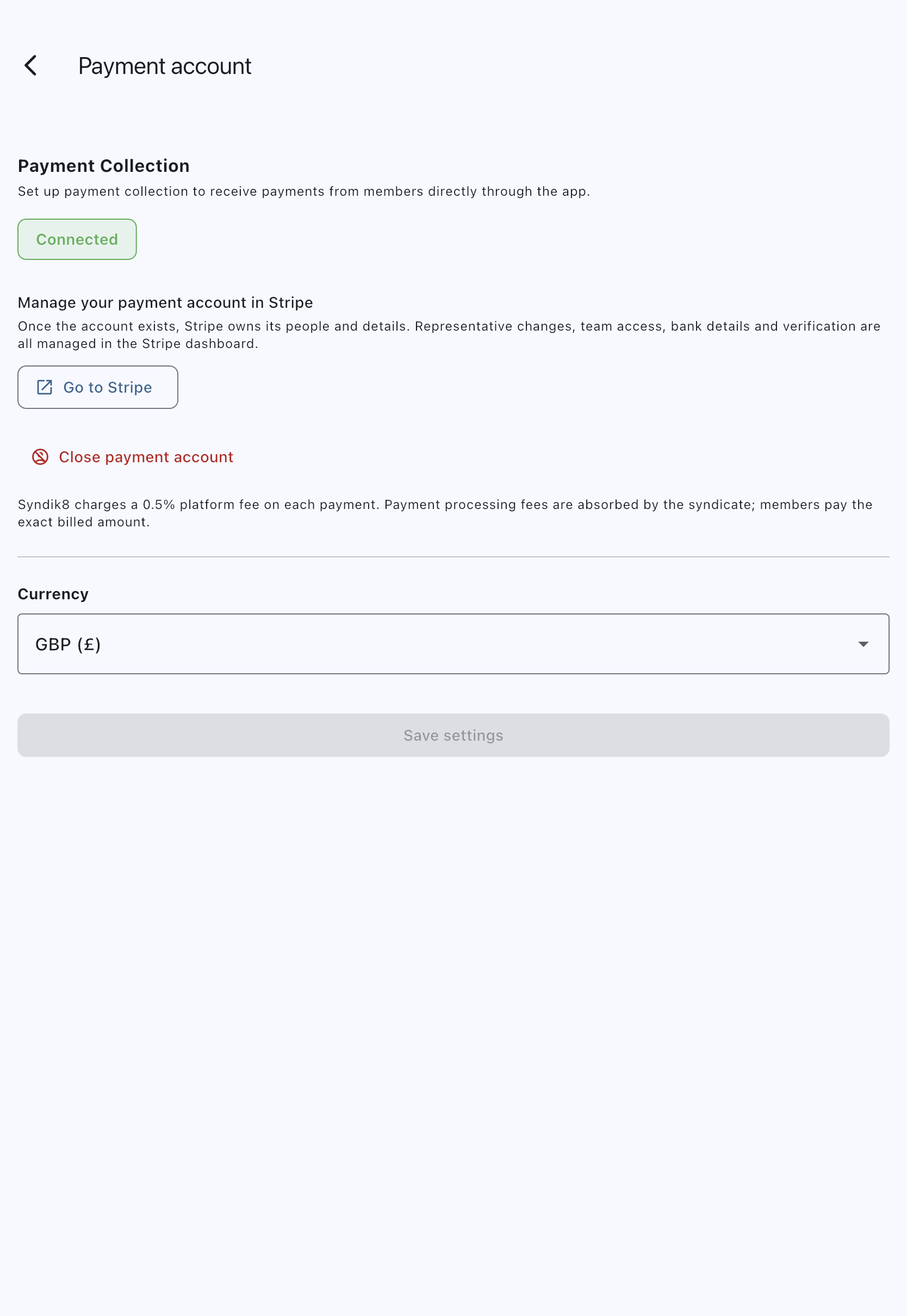
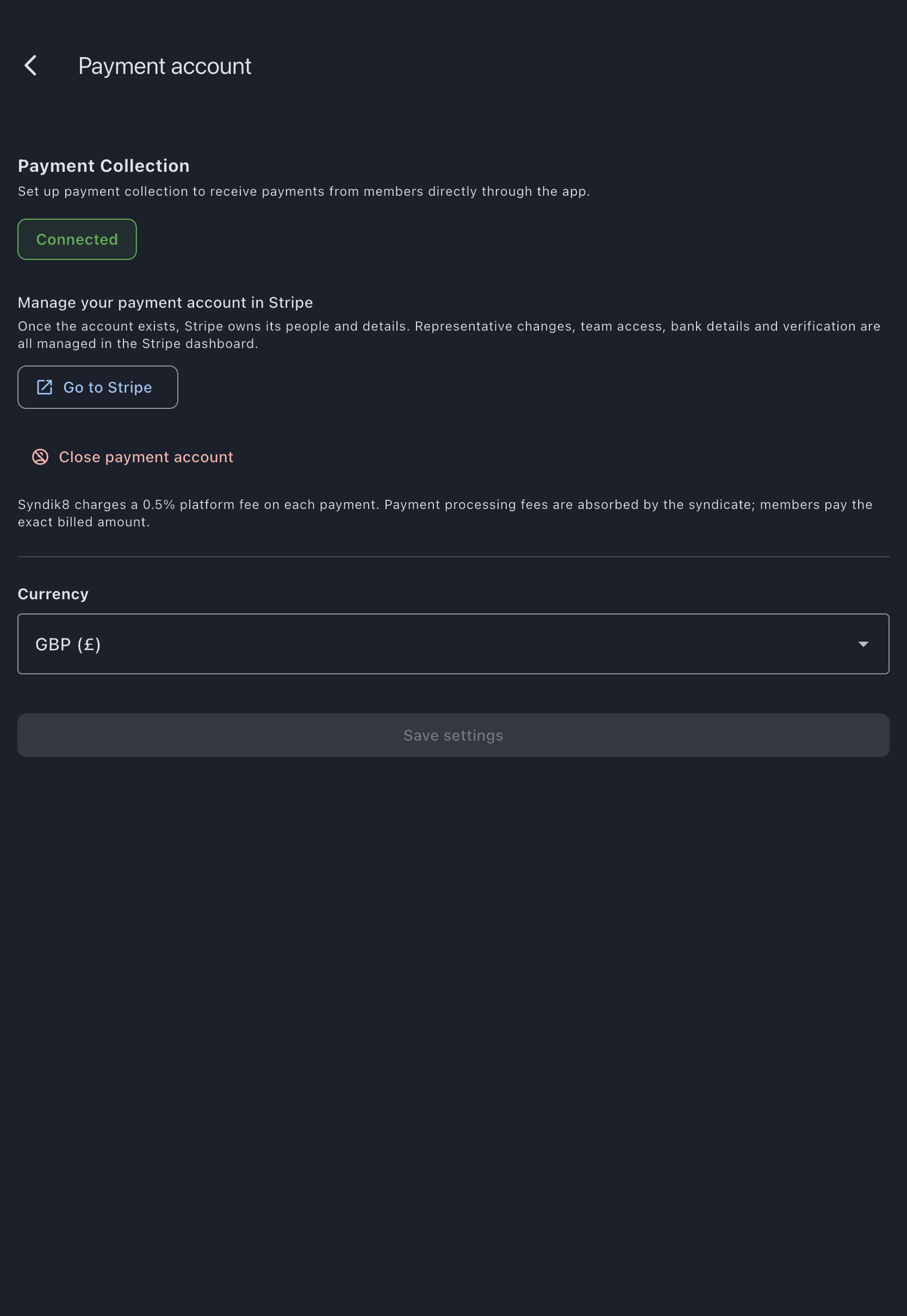
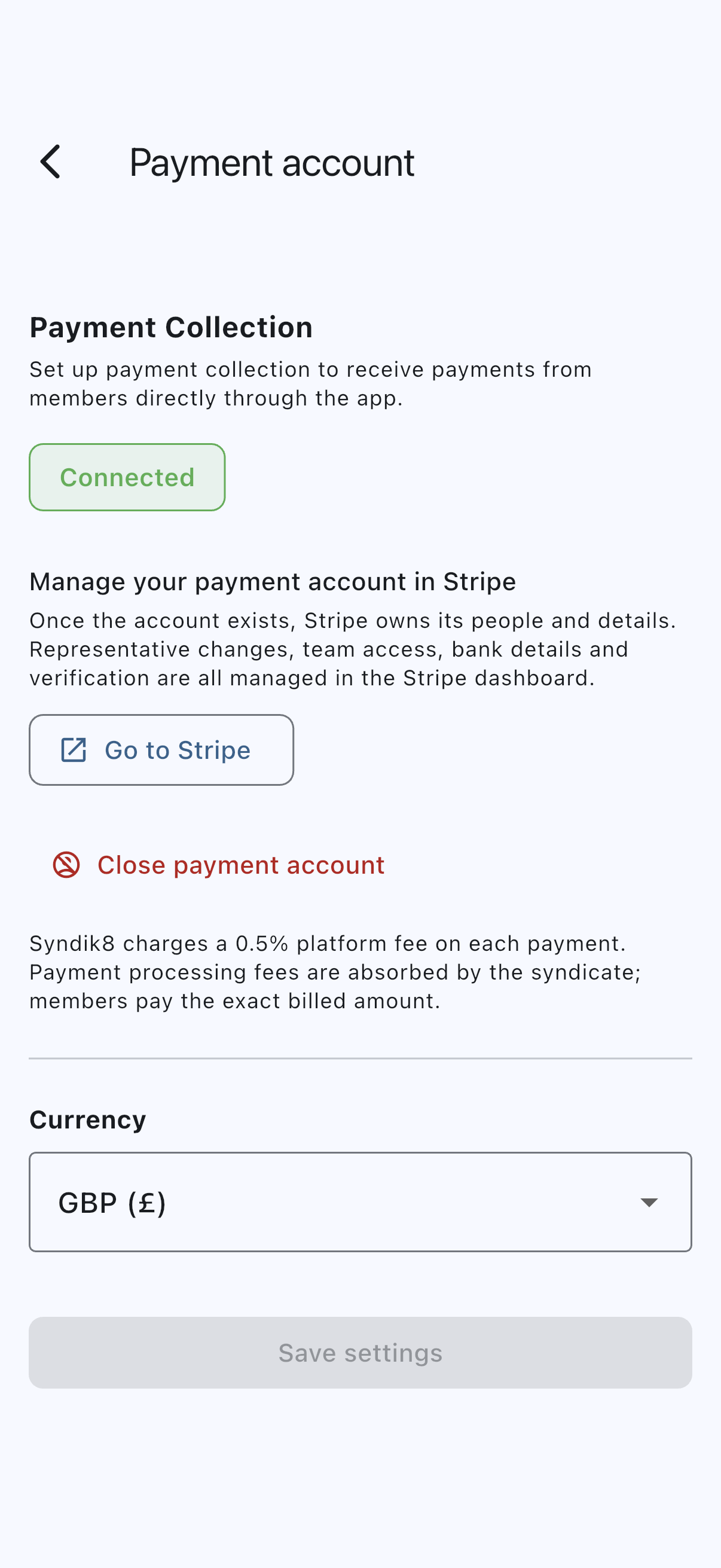
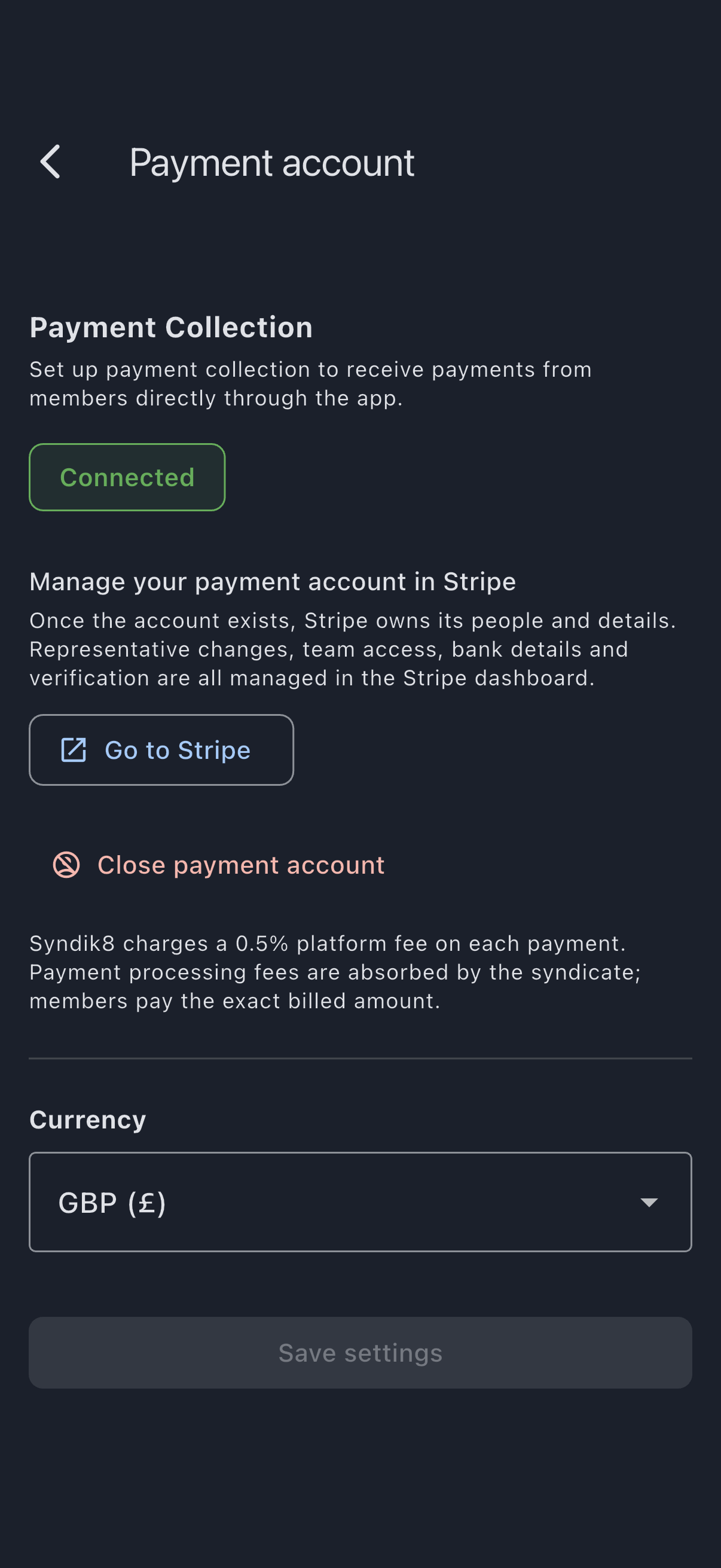
The status badge sits under Payment Collection on the Payment account screen, which the Payments hub row of the same name opens. It moves from Not connected through Under review to Connected once verification clears. Card and Direct Debit switch on as each capability is approved, so check the badge again later if only one is live at first. The full list of statuses, and the notifications each change sends to admins, is in Payment account and Billing.
Check your directors and owners against Companies House
Section titled “Check your directors and owners against Companies House”If your syndicate is set up as a limited company, the payment provider needs every director and everyone who owns 25% or more of it. Before you submit that list, you can cross-check it against the public record at Companies House, so nobody is left off by mistake.
Where to find it. It is the wizard’s Companies House check step, just before the bank account. Tap Check the register there. The step is optional: skipping it costs you nothing but convenience, because Stripe asks every director and 25%+ owner for their details directly regardless. The check sits inside the wizard, rather than somewhere to discover later, because confirming people is only useful before you submit — that is when their details can still be sent ahead.
From one lookup you have both follow-ups in reach: confirm each person on the results (which saves their public record to pre-fill their own form), or use Ask directors and owners for their details on the same step to have each flagged person fill in their own.
The check opens on your company registration number, already filled in if your syndicate has one saved. Confirm or correct it and tap Check directors & owners. The app looks the company up and lists the directors and 25%+ owners Companies House holds for it. If the number is wrong you get a “check the number” message; if the lookup itself could not run you get a “couldn’t reach Companies House” message, so an unknown result never reads as an empty board.
For each person on that list, the app suggests the member it thinks they are and asks you to confirm. Confirming is deliberate: it is the point at which that member’s Companies House date of birth and address are saved to pre-fill their own details form, so they review and complete them rather than start from a blank page. Nothing is ever matched for you, not even an exact name. Where two members could be the same person, you pick which one before confirming.
Some rows cannot be matched to a member, and the app says so rather than guessing:
- Someone who is not one of your members. The payment provider will collect their details directly.
- A corporate owner. This is a company that controls your company, so it is never a person and is never matched.
- A protected name. Where a person’s details are protected at Companies House, the name is withheld and the row is shown without one.
If Companies House lists a director or owner you have not accounted for, a warning at the top names them. Add them as members, or make sure the payment provider will collect their details, before you finalise payment setup, because the provider requires every director and every 25%+ owner regardless.
Pick up where you left off
Section titled “Pick up where you left off”Setup does not have to happen in one sitting. Reopening the wizard lands you on the first step you have not yet saved — everything already saved shows a tick in the progress strip, and your saved answers are filled in for you to review or edit. Because the bank account is never saved before you press Finish, a fully-completed-but-not-submitted session lands on the bank step with the numbers to re-enter.
If you already pressed Finish and Stripe accepted, reopening the wizard shows Details submitted instead of the steps: from that moment the account’s records belong to Stripe and cannot be edited in the wizard. Continue with our payments partner takes you back to Stripe’s pages if verification is not finished.
Stripe’s own link into those pages can only be used once, and it times out. Follow one that is spent and Stripe sends you back to a Payment Setup screen in Syndik8 reading Your setup link has expired, with a Get a new link button that fetches a fresh one and takes you straight back. If the account was finished in the meantime, the expired-link message gives way to the account’s actual state, with Back to Payments to return to the hub. Nothing you have already entered is lost, and nothing is blocked while you sort it out: Continue with our payments partner in the wizard gets you to the same place.
Update your details after setup
Section titled “Update your details after setup”Once your account is connected, the app can no longer change who or what is on it. Stripe takes ownership of the account’s records at that point, so the directors and owners, the registered representative, team access and the bank account can no longer be edited from inside Syndik8.
To make any of those changes, open the syndicate, go to the Admin tab, tap Payments, then Payment account, and under Manage your payment account in Stripe tap Go to Stripe. That hands you over to the syndicate’s own Stripe dashboard, which is where the account’s people and details live from then on. Stripe documents what you can do there in its dashboard documentation.
Go to Stripe appears only once your details have been submitted. If Stripe later comes back asking for more, the badge reads Action required and the button gives way to Continue Setup, which reopens Stripe’s pages at the step it wants; Go to Stripe returns once that is answered.
Keep the account up to date. A connected account whose directors, owners or details no longer match reality can fail Stripe’s periodic checks, and that surfaces later as a blocked payout rather than an obvious warning.
Change the payment representative
Section titled “Change the payment representative”The representative is the person Stripe holds responsible for the syndicate’s connected account. Changing who that is now happens in Stripe, not in Syndik8: tap Go to Stripe on the Payment account screen, and Stripe takes over from there. On a company account the role can be reassigned to another person. An individual / sole trader account is legally the account holder’s own and cannot be reassigned, so the way to change who is responsible is to close the payment account (the Close payment account button in the same section) and set it up again.
Handing the representative over is no longer forced before the person can go. If an admin leaves a syndicate that has a payment account, or is removed from one, the confirmation shows a reminder to make sure the Stripe representative role has been handed to someone else in Stripe. It is a prompt, not a block, because the app can no longer reliably tell who the Stripe representative is.
See also
Section titled “See also”- Payment account and Billing: the screen where you connect the account, and the sibling screen where you set the billing cycle
- Direct Debit: how members set up a mandate and how collections run once the account is active
- How payments work: the direct-charge model, the platform fee, and who handles refunds