
Apple Watch app
What it is
Section titled “What it is”The Syndik8 Apple Watch app is a wrist front-end to the same booking and billing engine the phone uses. It has two halves:
- Glance: complications, a Smart Stack widget, and a small app that show your next booking, your balance, and your aircraft’s availability. The glance covers every syndicate you belong to, one page per syndicate, with your default syndicate first.
- Flight capture: a step-by-step wizard that stamps your times and location as you tap, lets the Digital Crown set meter readings and airfields, and submits a real usage log against your booking.
It pairs with the Syndik8 app on your iPhone. The watch is a separate device with no direct access to the phone’s data, so everything it shows or sends travels over the Watch connection to your paired iPhone.
Who can use it
Section titled “Who can use it”Any member with an Apple Watch paired to an iPhone that has Syndik8 installed and signed in. The capture flow follows the same rules as logging a flight on the phone; you can only capture against your own confirmed booking.
Where to find it
Section titled “Where to find it”- Install Syndik8 on the paired iPhone first, then add the watch app from the iPhone’s Watch app (see Install the watch app).
- Requires an Apple Watch and an iPhone with Syndik8 installed. There is no standalone watch-only mode.
Fields / options
Section titled “Fields / options”Glance surfaces
Section titled “Glance surfaces”| Surface | Shows |
|---|---|
| Watch app | A page per syndicate, default first; each with that syndicate’s next booking and balance. Swipe or turn the Digital Crown to move between them. |
| Smart Stack widget | The next-booking and balance summary for your default syndicate. |
| Complication | A single Syndik8 complication you add to a watch face. What it shows adapts to the moment (see below). |
There is one Syndik8 watch complication, not several. What it shows changes with the situation, in priority order:
- A flight is ready. When a booking is ready to fly, it becomes a launcher: it shows the aircraft’s name, lights up, and tapping it opens straight to Start Flight.
- Otherwise, availability. When you have a favourite aircraft (or your syndicate has only one), it shows that aircraft’s availability.
- Otherwise, a quiet brand mark. With nothing to surface, it settles to a plain “Syndik8”.
It renders in whatever shape the watch face slot uses, showing a little more or less by shape:
- Circular: a “free today” gauge when showing availability; otherwise the brand mark.
- Corner: an inner glyph with a curved label around the edge. The curve is a “free today” gauge with the aircraft name for availability, the same name when a flight is ready, or the brand mark when idle.
- Inline (the single line of text above some faces): “Fly (aircraft)” when a flight is ready; “(aircraft) free” or “(aircraft) busy” for availability; your next booking otherwise; or “Syndik8” when there is nothing to show.
- Rectangular (the richest): for availability it shows the aircraft name, a five-column weather-style strip, and your next booking. The first column is labelled Today and is a plain free-or-busy reading of the aircraft right now, drawn with a border to mark it out; the four after it are the next four days, each coloured by how booked that day is, with a bar marking the days you have booked yourself. When a flight is ready it shows “Ready to fly” and the aircraft name; otherwise it shows your next booking and balance.
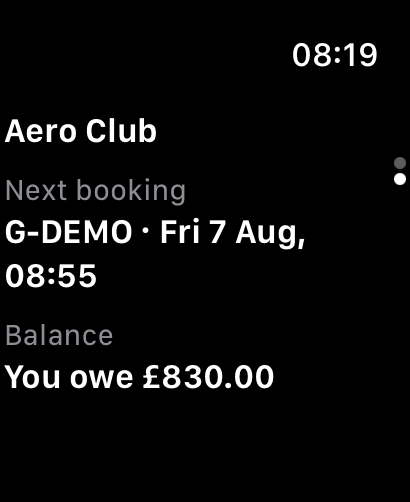
The watch screenshots are captured on a real Apple Watch rather than generated alongside the rest of the documentation, so the aircraft in them still carries an older registration than the G-Q… marks used on every other page.
Capture controls
Section titled “Capture controls”The capture wizard presents one step per screen so the Digital Crown always drives the control in front of you:
- Flight buttons: bookend the times your syndicate records: brakes off/on for block time, takeoff/landing for airborne time, or the full sequence when both are recorded.
- Digital Crown: sets the engine-meter readings (when a meter is captured), scrolls the list of nearby airfields, and scrolls the review summary.
Behaviour rules
Section titled “Behaviour rules”- The glance shows the last data your phone synced. Like the home-screen widget, it reflects what the iPhone app last had; so the phone app needs to have run and synced. If you have not chosen a default syndicate, the glance prompts you to set one in the phone app first.
- It follows your default syndicate, not the in-app selection. The complication and Smart Stack widget anchor to your default syndicate so an ambient surface stays stable. Set your default (and your favourite aircraft) in the phone app (see Choose your default syndicate, tab and aircraft).
- Dates match your account settings. Booking dates on the wrist use your chosen clock format and date order, the same as in the app. The incoming-debit line carries no date to format.
- Flight mode arms near your slot. When a booking is ready to fly (in its slot, or within two hours either side of its start), the watch opens to a Start Flight screen with the glance one swipe away. This works across all your syndicates, so a live booking on any of them arms the wrist. The capture binds to that booking’s own syndicate for billing.
- Capture mirrors what the syndicate captures. Tapping Start Flight opens the wizard full-screen so a stray swipe can’t drop you out mid-capture. The steps follow the syndicate’s capture mode: the engine-meter steps appear only when a meter is read; the airfield and landings steps appear for every aircraft; and the flight screen records block time, airborne time, or both.
- Capture submits a real usage log. A captured flight is submitted as a usage log through the same path the phone’s Log Flight screen uses, and is billed server-side. You do not need to re-enter it on the phone.
- The watch asks you to confirm no known defects, exactly as the phone does. Before you submit, the watch shows a “No known defects” confirmation, the pilot-in-command’s per-flight declaration. If the aircraft has a defect to report, you finish the flight on your phone instead: the watch does not collect defect details, it only handles the clean “no known defects” case.
- You are recorded as the pilot in command. There is no name field on a wrist, so the phone writes yours onto the log as it submits, exactly as the Log Flight screen does. It uses your display name, or your first and last name if you have not set one. If you have set neither, the flight records your account but leaves the pilot’s name blank rather than guessing, and it can be typed in by editing the log. To record someone else as pilot in command, log that flight on the phone.
- An offline capture is still logged. If your phone has no connection when you finish, the flight is saved on the phone and uploaded automatically when it next syncs; there is no separate draft to submit.
- The watch carries no airfield data, so no flight can be captured without the phone. Nearby-airfield lookups are answered by the paired iPhone. With the phone out of range the airfield step has nothing to offer and Confirm stays disabled, so the capture cannot get past Departure at all — and again at Arrival. This is not a degraded list; it is a stop.
- Location permission is required to capture a flight, for the same reason. The airfield step offers the airfields nearest to you, so the watch has to know where you are. Allow location when the watch asks, and the step works; decline it and the step has nothing to offer, exactly as it does with the phone out of range. There is no way to type an airfield in on the watch, so this is not a preference — without location, capture a flight on the phone instead. If you declined once, the prompt does not come back: turn it on in the Watch app under Syndik8, then Location.