
Collect by Direct Debit
Collect by Direct Debit
Section titled “Collect by Direct Debit”Direct Debit collects what is due, a set number of working days after it became due. There is no separate collection timetable to keep in step with your billing: the bill decides when a charge is demanded, and Direct Debit follows it.
Before you start
Section titled “Before you start”- You need an admin role in the syndicate (treasurer counts as admin).
- The syndicate payment account must be connected and the Direct Debit capability must be active. See Payment account and Billing.
- Each member you want to collect from must have an active Direct Debit mandate. A member sets up a mandate from their Balance screen, as described in Set up Direct Debit. Until a member has signed their mandate, there is nothing to collect against and they are skipped.
- Open the Admin tab, tap Payments, then tap Direct Debit. The card-payment delay, the Collect now action and the register of member mandates are all on the screen that opens.
Prompt members to set up a mandate
Section titled “Prompt members to set up a mandate”A member must have a mandate before you can collect. To nudge one member, open that member’s detail dialog and choose Prompt to set up Direct Debit. This sends them an in-app notification, a push, and an email that links straight to setup. If their mandate is half-finished, they should start Direct Debit setup again, which sends a new consent link from Stripe.
Prompt members one at a time. Members can also set up a mandate themselves from the card on their Balance screen without a prompt.
Set the card-payment delay
Section titled “Set the card-payment delay”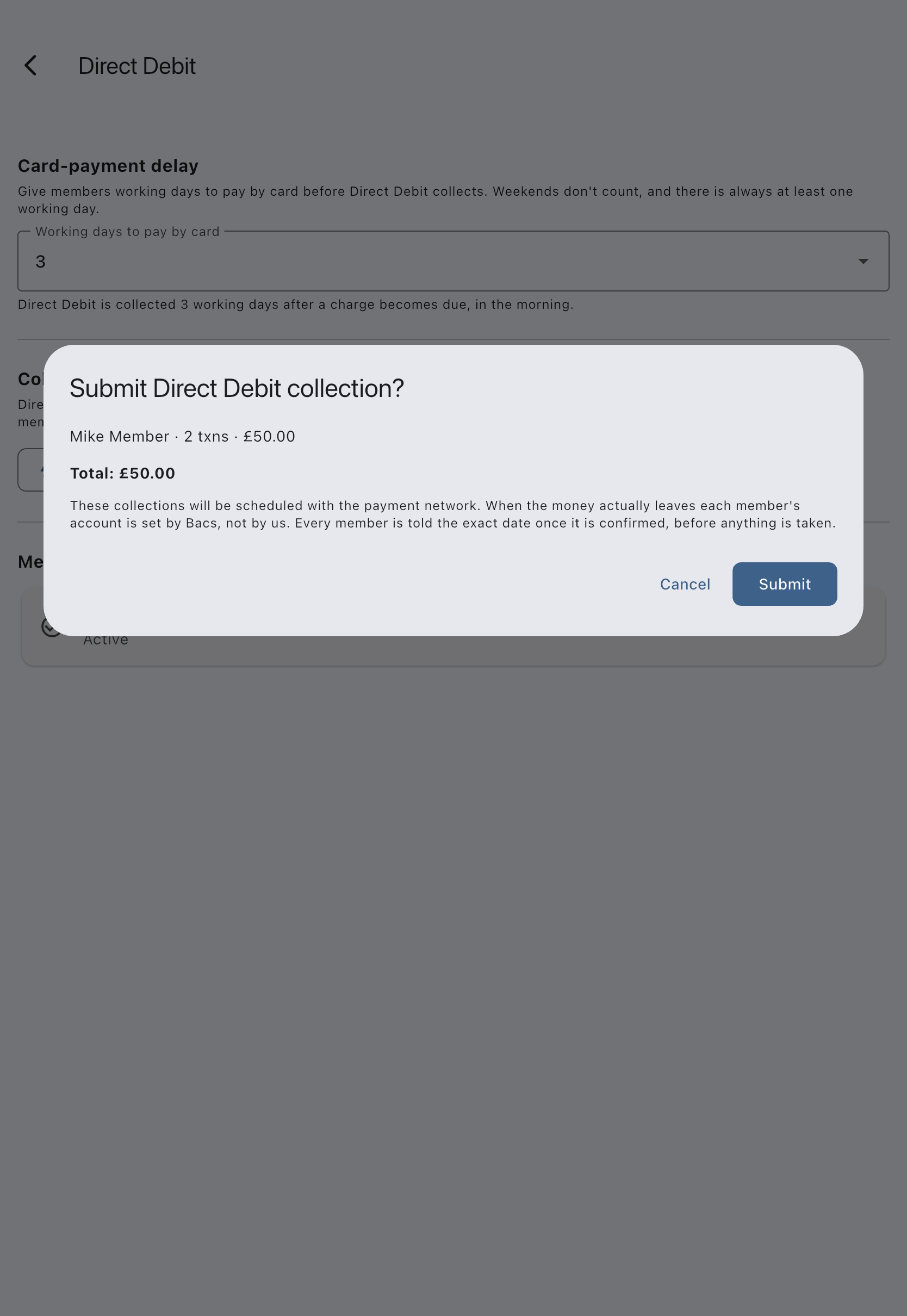
- Under Card-payment delay, choose how many working days members get to pay by card before Direct Debit collects.
- The choice saves as soon as you make it.
The delay counts working days, so weekends do not count: a charge that becomes due on a Friday with a delay of three is submitted for collection the following Wednesday morning, not Monday. Bank holidays are not modelled, so a delay that lands on one is submitted that morning like any other weekday. The day the money actually leaves the member’s account is the payment provider’s to choose, a few working days later.
The minimum is one working day, and the default is three. You cannot set it to zero: a member who has just been billed always gets at least one working day to settle by card before the money is taken from their bank account.
A member who pays by card inside the delay has nothing left to collect, so Direct Debit passes them by. A member who does not is collected automatically, without an admin pressing anything.
Whether a charge counts as due depends on the syndicate’s billing due mode, which is set on the Billing screen. See close the billing period. A syndicate that bills on finalisation has nothing to wait for: every charge is due the moment it is raised, so the delay starts counting from then. A syndicate that bills at close accrues charges quietly between closes, so nothing is collected from an at-close member until an admin closes the period, and the delay starts counting from the close.
Every collection, whether automatic, Collect now, or triggered by a close, takes the member’s net balance: their due charges minus any unsettled credits, even credits that haven’t been billed yet. The one thing never swept early is a cash call. Every cash call has a due date, chosen when you issue the call, and no collection touches the charge until that date arrives, after which it’s collected like any other due balance. Closing the billing period does not bring it forward.
Members see the same rule on their own screen: until the due date, their share of a cash call is not in their balance figure, not in their Outstanding list, and not in Pay All. It sits in a Cash calls not due yet card with the date on it, and a member who wants to settle early can pay it from there. If the date itself is wrong, an admin can correct it without cancelling the call: that moves the date on every member’s charge as well, so the collection follows it, and the charged members are told it has moved. It is refused while a collection is already holding one of the call’s charges.
Collect now
Section titled “Collect now”Collect now is the manual override for a treasurer who wants the money moving today rather than waiting for the delay to elapse.
- Under Collect outstanding balances, choose Collect now.
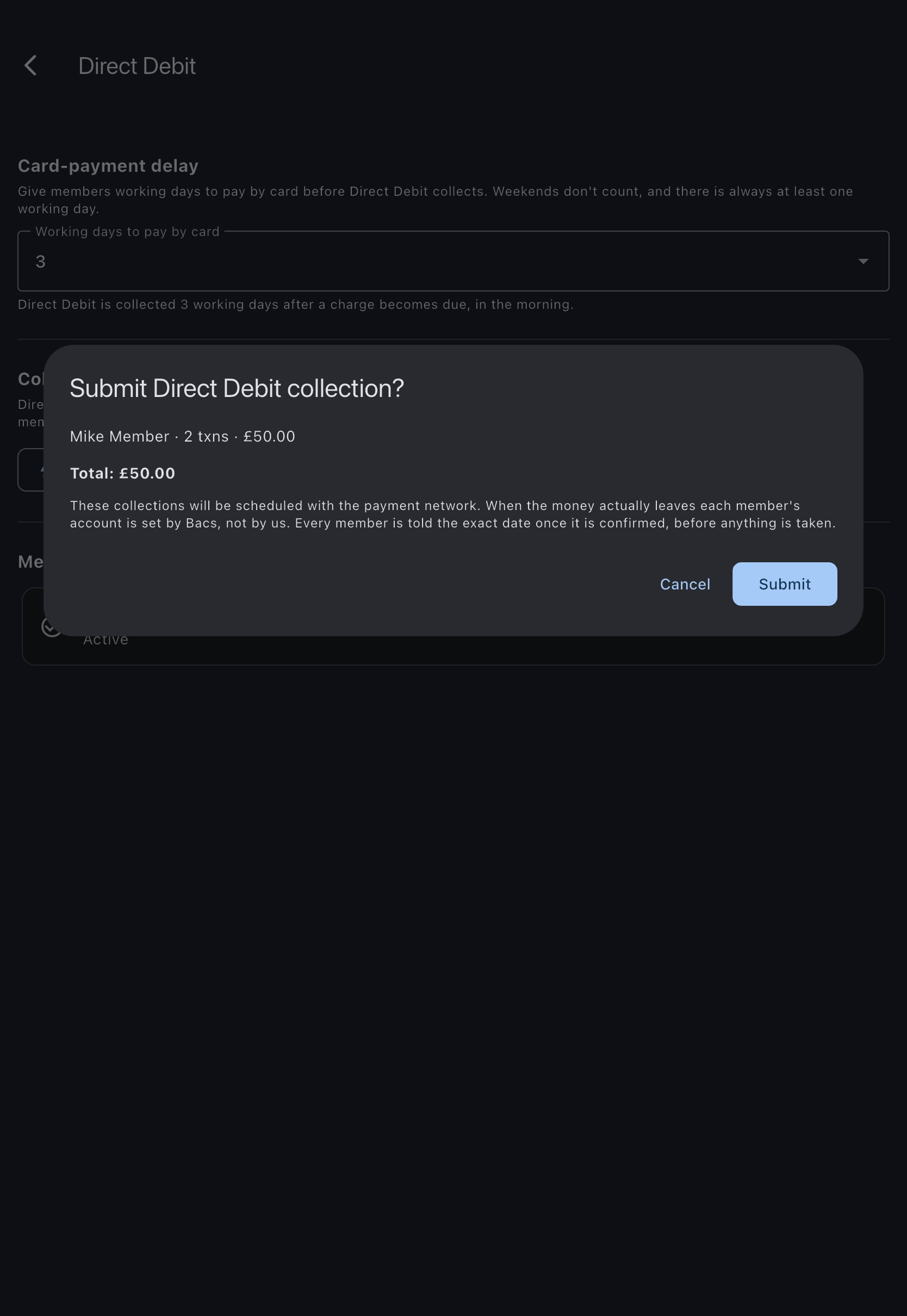
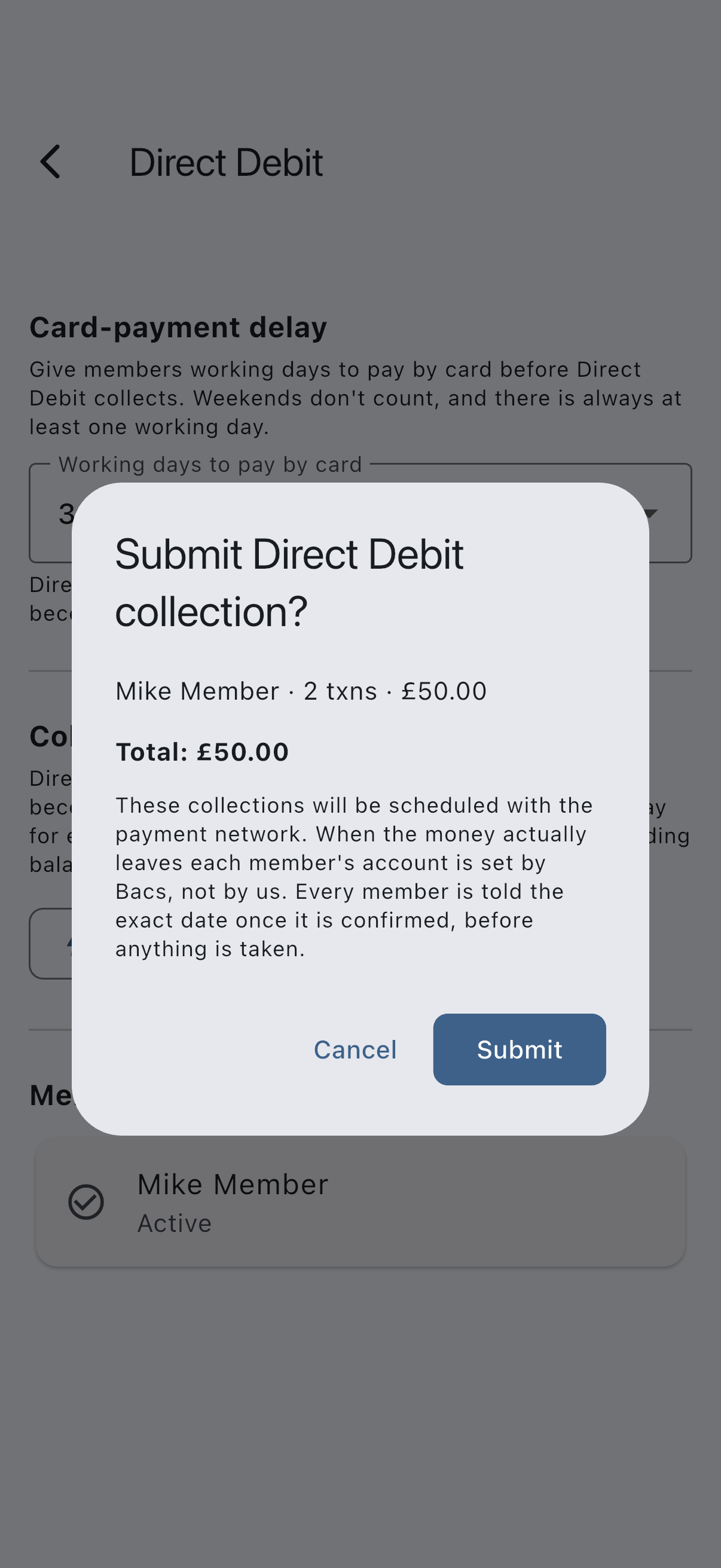
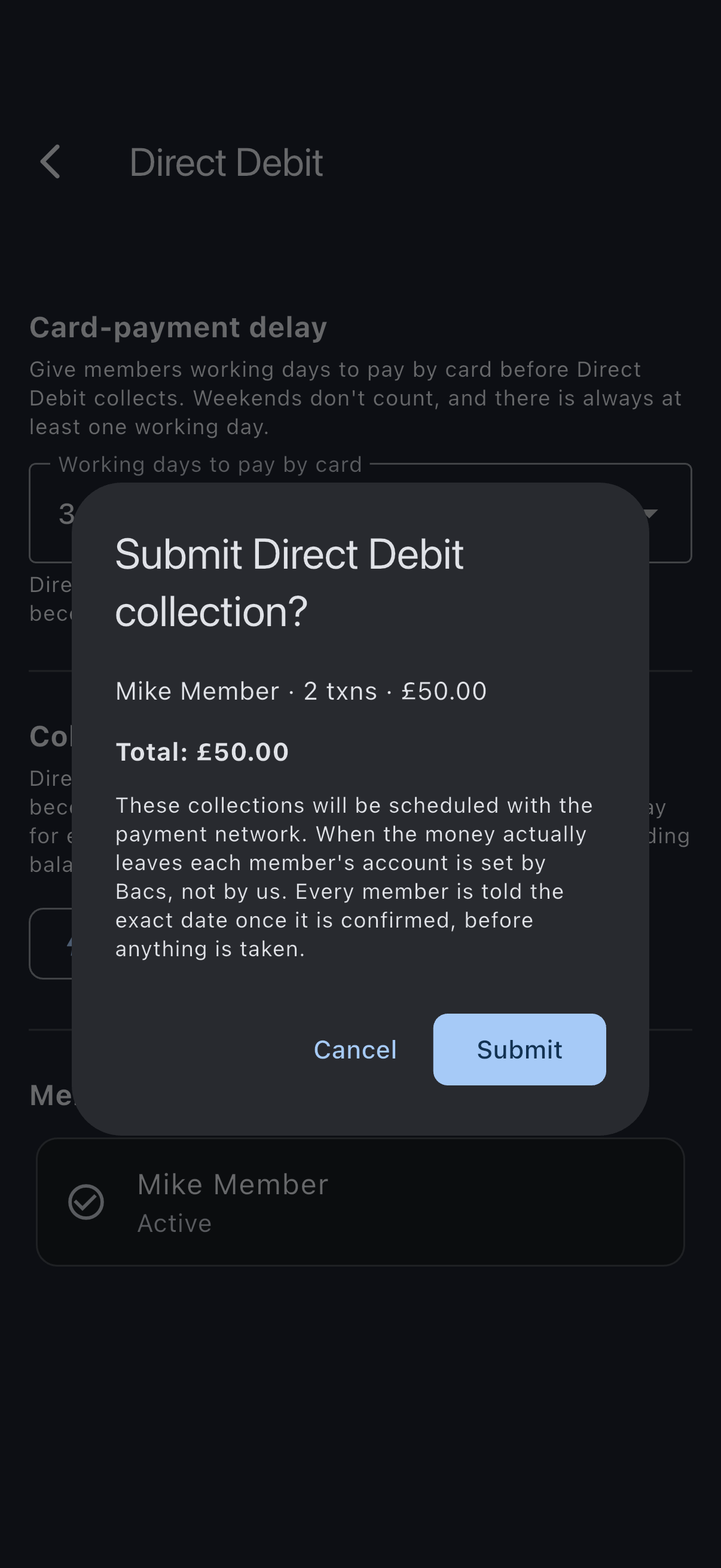
- Review the preview, which lists the amount due per member and the total beneath them.
- Check whether anyone is listed under Left out of this collection, and read why.
- Tap Submit to start the collections.
A member is included only if they have an active mandate and a due balance. On an at-close syndicate, that means Collect now pulls nothing until you’ve closed the billing period at least once; afterwards it collects whatever has become due since.
Members left out
Section titled “Members left out”A member appears under Left out of this collection when they owe money that cannot be taken right now. The usual reason is that an earlier Direct Debit collection of theirs has not resolved yet: only one collection per member can be outstanding at a time, so a second would be refused in full rather than trimmed. They are listed with their balance and the reason rather than quietly dropped, because a list that just stops short reads as “nobody else owes anything”.
The total shown above them, and the collections the confirmation reports as submitted, both exclude these members — so the figure you read is the figure that will be debited. After you tap Submit, the confirmation names both counts, for example “Submitted 1 collection — 1 member was left out”.
There is normally nothing to do about it. The balance stays owed and goes out on the next run once the earlier collection resolves. If you need the money sooner, take it another way and record it as an external payment against the member’s balance.
Each member receives an advance notice before the money leaves their account. Syndik8’s own “debit incoming” notice names the amount and says the money will leave over the next few working days; it does not name a day, because the payment provider decides when a collection goes and does not tell us what it chose. The provider’s advance-notice email carries the date.
Stop collecting from a member
Section titled “Stop collecting from a member”There is no syndicate-wide switch to pause collection, because collection is not on a timetable of its own: it follows the bill. To stop money moving, stop charges becoming due — leave the syndicate on at close and don’t close the period, and turn off automatic monthly billing on the Billing screen.
To stop collecting from one member, cancel their mandate. A member can cancel their own mandate from their Balance screen at any time, and the Direct Debit Guarantee gives them that right regardless of what the syndicate does.
After a collection
Section titled “After a collection”A Direct Debit clears over a few working days, so a collection stays in progress for a short while before it succeeds. Members can follow each payment in their Payment History. If a collection fails, the member and the admins are notified, the charges are released, and they are picked up again on the next run.
Very occasionally a collection request cannot be confirmed either way — it times out, say, so there is no way to know whether the bank received it. The member’s charges stay held while that is unresolved, deliberately: releasing them could mean paying twice for money already on its way. Admins are alerted, and it is sorted out by hand.
See also
Section titled “See also”- Direct Debit: what a Direct Debit is and how mandates, advance notices, and the guarantee work.
- Cash calls: the one charge a collection waits on, and what the member sees in the meantime.
- Set up Direct Debit: the member-side steps for signing a mandate.
- Payment account and Billing: connecting the syndicate payment account, and the billing cycle the delay counts from.